Preferred office location:
Please select your nearest office location so we can show you the most relevant information.

Your preferred office location
Our Criminal team discuss this important topic.
If you applied for the Restraining Order, you will be the “Applicant”, and the “Person Protected” for the purposes of the proceedings.
If you have been served with a Restraining Order, you will be the “Respondent”, and the “Person Bound” for the purposes of the proceedings.
It is important that you understand the type of Restraining Order that you have applied for or, been served with as the settlement options available to you
If you are granted an Interim Order on the date of your ex-parte Hearing in the Magistrates Court, it will remain in effect until such time that the order has been either settled by way of an Undertaking, Mutual Undertaking or Conduct Agreement Order, or, until such time that the order becomes “Final”. Or, if the application is withdrawn or dismissed by the Court.
An Interim Order can be made Final if:
The Interim Order that you have been served with allows you the option to either consent or object to that order.
If, at any stage in the proceedings, you do not attend either a Directions Hearing or the Final Order Hearing, a Final Order will be granted to the Applicant in your absence.
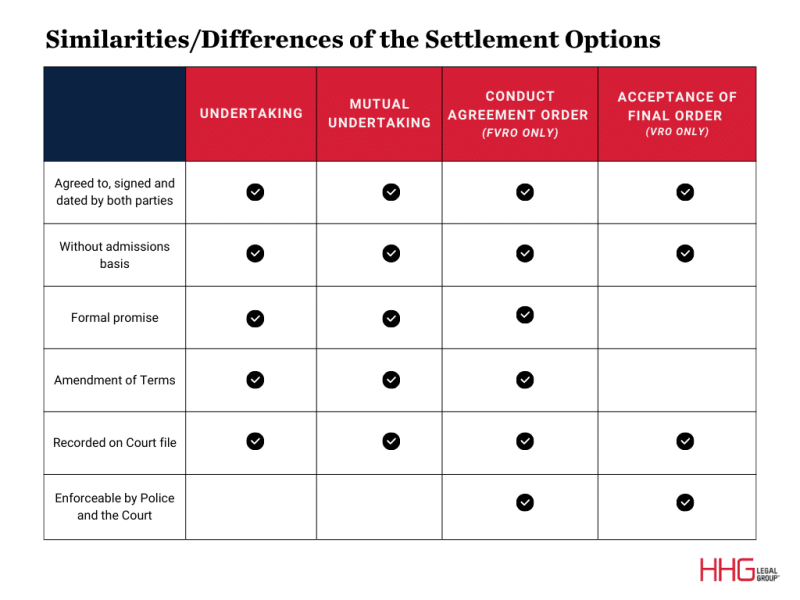
There are three (3) settlement options available to the parties. Each option, if agreed to, are signed on a “without admission basis” and if agreed to by both parties, the agreement will be placed on the Court file and the Interim Order will be substituted.
An Undertaking is a formal promise to the Court that the Respondent will refrain from engaging in certain types of behaviours. Undertakings usually include the same terms as the FVRO. However, they can be amended with terms being added, or removed, as agreed by the parties.
Undertakings are agreed to, signed and dated by the parties on a “without admission basis” which means that the Court acknowledges that the Respondent does not admit to anything alleged to have happened by the Applicant in their Application.
Undertakings are recorded on the Court file. However, they are not a binding or enforceable Court Order. This means that should the Respondent breach any of the terms or conditions of the Undertaking, the Respondent will not be charged with a criminal offence of Breaching a Restraining Order. The Applicant rather will have recourse to apply for another Restraining Order.
A Mutual Undertaking is similar to that of an Undertaking however, both parties will have made an unenforceable promise to the Court to refrain from engaging in certain types of behaviours. Both parties cannot breach the terms of the Mutual Undertaking, the terms can be amended, and it must be agreed to and signed on a “without admission basis”.
A Conduct Agreement Order (CAO) is an Order which is signed on a “without admission basis” by both parties. A CAO usually includes the same terms as the FVRO but can be amended alike Undertakings.
A CAO is enforceable by both the Police and the Courts. This means that there will be criminal implications if the terms and conditions of the Order are breached, and the Respondent can be charged with a criminal offence of Breaching a Restraining Order.
A Final Order Hearing is when the evidence of the parties will be presented before the Court and a determination will be made as to whether, or not, a Final Order should be granted to the Applicant. A Final Order Hearing involves questioning and cross-examination of the parties, witness evidence, and documents to be prepared and filed with the Court prior to the Hearing.
As described above, an Undertaking or Mutual Undertaking are also available to the parties to a VRO.
Similar to a Conduct Agreement Order, the Respondent can accept the Interim Order as a Final Order however, on a “without admission basis”. The Acceptance is enforceable by the Police and the Courts and there are criminal implications for the Respondent for a Breach a Restraining Order.
Does an Interim Order, Final Order, Undertaking, Mutual Undertaking or Conduct Agreement Order appear on your National Police Clearance or History for Court?
No.
If the Respondent pleads guilty or is found to be guilty for the offence of a Breach of Restraining Order, this conviction would appear on a National Police Clearance or History for Court.
Courts encourage parties to attempt to settle restraining order matters where appropriate. Settlement can reduce stress, legal costs, and the time involved in progressing to a Final Order Hearing.
However, not all matters can be resolved this way. In some cases, a final decision by the Magistrate is necessary.
If you are unsure which option is right for you, legal advice can help you understand the risks, benefits, and likely outcomes based on your individual circumstances.
*The information provided in this website serves as a general guide and does not constitute legal advice. It is based on our research and experience at the time of publication. Please consult our knowledgeable legal team for any specific inquiries or advice relevant to your circumstances, as the content may not have been updated subsequently.

Please select your nearest office location so we can show you the most relevant information.